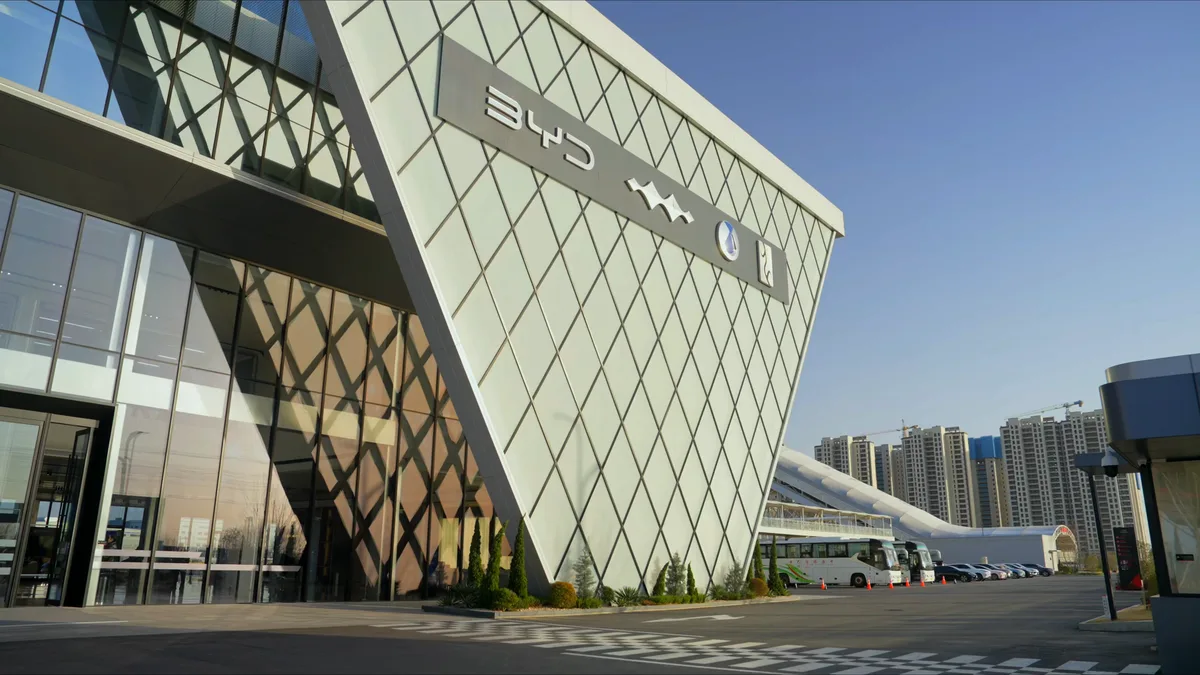
Byd
| Model | BYD |
|---|---|
| Country of origin | China |
| First created | 2003 |
| Original use | Affordable family car |
| Body style | Sedan |
| Powertrain | Electric or plug-in hybrid |
| Drivetrain | Front-wheel drive |
| Battery warranty | Typically 8 years or 160,000 km |
Origin and history
BYD originates from China and was founded in the mid-1990s. The company began as a manufacturer of rechargeable batteries, primarily for mobile phones and other electronics. This foundational expertise in battery technology directly informed its later strategic pivot into the automotive sector. BYD entered the automobile manufacturing business in the early 2000s, acquiring a state-owned car company to establish its production base. Its early automotive efforts focused on conventional internal combustion engine vehicles, including sedans and microvans. The company's long-term vision, however, was always aligned with new energy vehicles, leveraging its core battery competency to eventually become a global leader in electrification.
What it is designed for
BYD vehicles are designed primarily as practical, accessible, and efficient transportation for the mass market. The core design philosophy centers on electrification, with a strategic focus on plug-in hybrid and pure electric powertrains to reduce fossil fuel dependence. Models are engineered to offer competitive range, both electric and total, at a price point that undercuts many traditional Western and Japanese automakers. The design extends to interior space utilization, often maximizing cabin and cargo room within a given vehicle footprint for family usability. Technology integration is a key focus, with large rotating touchscreens and connected services featuring prominently to appeal to tech-savvy buyers. Ultimately, BYD cars are designed to be compelling alternatives to established brands by offering advanced electrified technology without a prohibitive premium.
Development and versions
BYD's automotive development has progressed through distinct phases, beginning with licensed and reverse-engineered internal combustion models. The pivotal shift came with the launch of its "Dynasty" series of plug-in hybrid and electric vehicles in the 2010s, such as the Tang and Qin models. Parallel to this, the company developed its proprietary "Blade Battery," a lithium iron phosphate (LFP) cell architecture praised for its safety and durability, which became a cornerstone for subsequent models. A major expansion occurred with the introduction of the "Ocean" series, a more stylistically distinct and often purely electric lineup including the Seal and Dolphin. The company also launched the Yangwang brand for the luxury segment and the Fangchengbao brand for off-road oriented vehicles, showcasing vertical expansion. Continuous over-the-air software updates and iterative hardware improvements are standard, with frequent model year enhancements to battery capacity, motor power, and driver-assistance systems.
Byd specs
Specifications vary significantly across BYD's extensive model range, but consistent technological themes exist. Powertrains typically include pure electric (EV) and plug-in hybrid (PHEV) options, with the latter often employing a dedicated hybrid transmission. Standard equipment is often generous, typically including synthetic leather upholstery, panoramic glass roofs, comprehensive LED lighting, and the signature rotatable central touchscreen infotainment system.
Byd problems
Some owners report inconsistent build quality, with issues such as misaligned body panels, interior trim rattles, or wind noise around windows on early production examples. The complex infotainment system, while feature-rich, can suffer from laggy responsiveness, unintuitive menu structures, or occasional software glitches that require reboots. The ride quality on some models, particularly those equipped with large wheels and sporty suspensions, can be overly firm and transmit sharp impacts into the cabin on broken road surfaces. Dealership and service network experiences outside of China can be inconsistent, with variability in technician training on the novel powertrains and longer wait times for specific parts. The driver-assistance systems, though present, are often described as less polished and smooth in their operation compared to the leading systems from established premium manufacturers. Residual values in many Western markets remain an unknown and potentially volatile factor due to the brand's relative newness and rapid model iteration.
Overview
BYD represents a formidable and vertically integrated force in the global shift towards electric mobility. The brand's strength lies in its control over the core battery technology, which allows for cost management and innovation in energy density and safety. Its product strategy successfully covers a broad spectrum, from affordable city cars to luxury performance vehicles, all unified under an electrified umbrella. The ownership experience is defined by very low running costs for daily electric driving, generous standard equipment, and a distinct, tech-forward interior environment. However, the vehicles often trade ultimate dynamic polish, cabin material richness, and brand cachet for their value proposition and technological showcase. It is a brand for buyers prioritizing the electrified powertrain and its benefits above traditional automotive prestige.
What to know
Prospective owners should know that BYD's plug-in hybrid models are engineered to prioritize electric driving; regular access to a home or workplace charger is essential to realize the full economic and environmental benefits. The warranty coverage, particularly on the battery pack, is often comprehensive and long-lasting, but the exact terms and what constitutes acceptable degradation should be reviewed carefully. Insurance costs can be higher than for equivalent conventional vehicles, due to the high repair costs associated with integrated battery packs and the relative scarcity of repair data. The rapid pace of model development and improvement means a newly purchased car may feel superseded by a newer, better-equipped version within a relatively short timeframe. While the touchscreen is the control hub for most vehicle functions, the reliance on it for basic operations like climate control adjustment can be a distraction while driving. Research into the service network coverage and capability in your specific region is a critical step before purchase.
Common questions
A common question is whether BYD cars are reliable, to which the answer is that the core powertrain and battery technology have demonstrated good durability in fleet use, but long-term data on newer models is still accumulating. Many ask how the Blade Battery differs, which is a lithium iron phosphate chemistry that is more stable and puncture-resistant than some other lithium-ion types, though often with slightly lower energy density. Buyers frequently inquire about charging times, which depend on the charger used; using a standard domestic outlet will be very slow, while a dedicated home wallbox or public fast charger dramatically reduces the time. People wonder about the availability of spare parts, which has historically been a challenge in some export markets but is improving as the brand's logistics networks mature. A recurring question concerns the brand's name, which stands for "Build Your Dreams," a phrase often found on the vehicle's badging. Another frequent query is about the real-world electric range, which, like all EVs, can be significantly less than the official figure in cold weather or during sustained high-speed driving.
Pros and cons
Pros: The primary advantage is exceptionally low fuel and maintenance costs for daily commuting when charged regularly, thanks to efficient electric drivetrains. The value proposition is strong, offering advanced plug-in hybrid or electric technology, generous equipment levels, and spacious interiors for a price often below key competitors. The Blade Battery technology provides a tangible safety benefit, with a strong track record for thermal stability and reduced fire risk. Performance from the dual-motor electric models is startlingly quick in a straight line, offering acceleration that rivals expensive performance cars. Standard equipment is rarely sparse, with features like heated seats, panoramic roofs, and advanced infotainment typically included in base models. Cons: The common regret involves the driving experience, which can feel disconnected, with numb steering, a sometimes brittle ride, and brake pedal feel that lacks linearity, especially in regenerative braking modes. A frequent mistake is buying the car for its technology without considering the ergonomic compromises, such as the over-reliance on touchscreen menus for basic functions. Interior quality, while improving, often uses hard, shiny plastics in lower-tier models and lacks the tactile sophistication of established rivals, leading to a perception of cheapness. The brand's rapid growth can lead to inconsistent after-sales service, where a customer's experience is heavily dependent on the competence of their local dealership. Residual value uncertainty is a significant financial con, as the market has not yet established stable long-term depreciation curves for the brand in many regions.
Who it suits
BYD suits cost-conscious pragmatists who want to adopt electric or plug-in hybrid technology without paying a premium badge tax. It is ideal for suburban families or commuters with predictable daily routes, access to home charging, and a primary need for spacious, well-equipped, and economical transportation. The brand appeals to tech enthusiasts who prioritize having the latest in-car infotainment and connectivity features over traditional driving dynamics or luxury finishes. It is a good fit for environmentally motivated buyers who want a fully electric vehicle or a plug-in hybrid they can drive primarily on electricity, but who require the flexibility of a gasoline engine for longer trips. BYD is less suited to driving enthusiasts who prioritize chassis feedback, steering feel, and a polished ride-handling balance, or to buyers for whom brand image and interior material prestige are primary purchase drivers.